
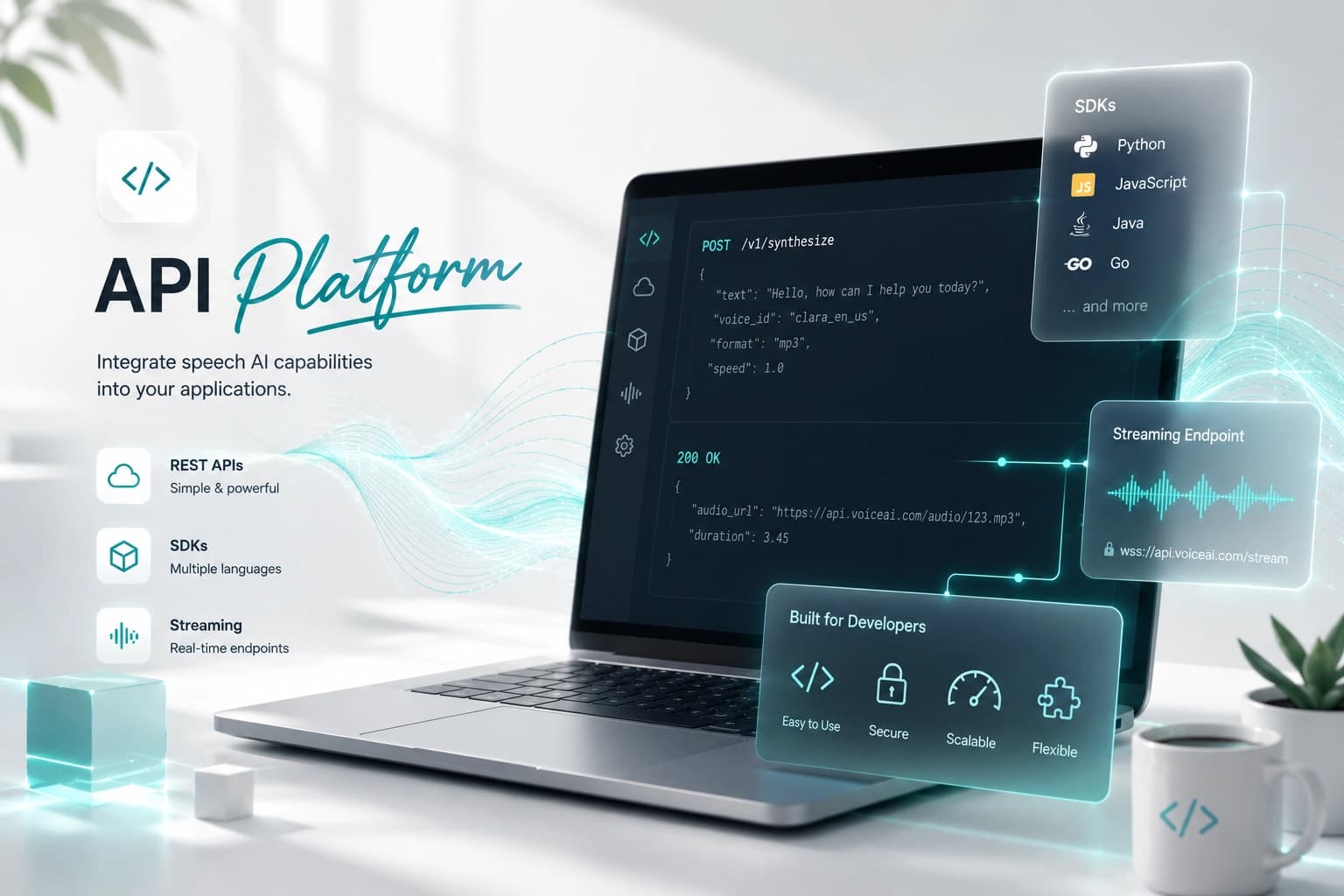




Build Faster with Clear Developer Guides
Raritone documentation is designed to help developers integrate Speech AI capabilities quickly and efficiently. Whether you're making your first API request or deploying enterprise applications, you'll find practical guides, code examples, and technical references in one place.
From signup to first call
Five steps to integrate the Raritone API end-to-end.
- STEP 01↓ next
Create a Raritone account
Sign up in under a minute. No credit card required.
- STEP 02↓ next
Generate your API key
Provision keys from the dashboard with scoped permissions.
- STEP 03↓ next
Review authentication
Learn how requests are signed and how to secure secrets.
- STEP 04↓ next
Make your first request
Hit the synthesis endpoint and receive audio in ms.
- STEP 05
Integrate into your app
Ship to production with SDKs, webhooks, and streaming.
Find what you need, fast
Every guide is organized to match the way developers actually build—pick a section and jump in.
Getting Started
QuickstartCreate an account, generate API keys, and set up your first project.
Read guideAuthentication
SecurityUnderstand API authentication, security best practices, and access.
Read guideAPI Reference
ReferenceEndpoints, request parameters, response formats, and error codes.
Read guideSDKs & Libraries
ToolingSDKs and code samples for popular programming languages.
Read guideCode Examples
ExamplesPractical examples for voice generation, recognition, and integration.
Read guideWebhooks
EventsReal-time event notifications for completed requests and events.
Read guideEvery capability, one reference
Dedicated guides for every endpoint—complete with parameters, response shapes, and working code.
AI Voice Generator
Generate lifelike voices from text with fine-grained style controls.
Voice Cloning
Build secure, consent-first custom voice profiles from samples.
Text-to-Speech
Convert text into natural speech across 70+ languages in real time.
Speech-to-Text
Transcribe audio with diarization, punctuation, and timestamps.
Voice Management
Organize, version, and share voices across projects and teams.
Streaming API
Low-latency, bidirectional streaming for live audio applications.
Ship reliable, scalable voice apps
Build reliable and scalable applications by following recommended implementation guidelines.
Secure API Key Management
Store keys in env vars or a secrets manager—never commit them.
Request Validation
Validate payloads on the client and server to catch mistakes early.
Error Handling
Map error codes to user-facing messages and structured logs.
Rate Limit Management
Throttle requests, batch where possible, and respect retry headers.
Performance Optimization
Stream audio, cache responses, and choose the right model tier.
Retry Strategies
Use exponential backoff with jitter on 429s and 5xx responses.
Logging & Monitoring
Track latency, error rate, and cost per call with structured logs.
Production Deployment
Provision regional endpoints and enable failover.
Bookmark these
The handful of links you'll keep coming back to while you build.
Decode any non-200 response
Every error code, what it means, and how to recover.
Bad Request
Invalid request parameters.
Unauthorized
Authentication failed.
Forbidden
Access denied.
Not Found
Resource not found.
Too Many Requests
Rate limit exceeded.
Server Error
Internal server error.